IPv6 Addresses
Internet Protocol version 6 (IPv6) is the newer version of the Internet Protocol (IP). It was initially expected to replace IPv4 in a short enough time, but for now, it seems that these two versions will coexist on the Internet in foreseeable future. Nevertheless, IPv6 becomes more important, as the date of the unallocated IPv4 address pool's exhaustion approaches.
The two main benefits of IPv6 over IPv4 are:
- much larger address space;
- support of stateless and stateful address auto-configuration;
- built-in security;
- new header format (faster forwarding).
IPv6 uses 16-byte addresses compared to 4-byte addresses in IPv4. IPv6 address syntax and types are described in RFC 4291.
There are multiple IPv6 address types, that can be recognized by their prefix. RouterOS distinguishes the following:
- multicast (with prefix ff00::/8)
- link-local (with prefix fe80::/10)
- unique local addresses (with prefix fc00::/7)
- loopback (the address::1/128)
- unspecified (the address::/128)
- other (all other addresses, including the obsoleted site-local addresses, and RFC 4193 unique local addresses; they all are treated as global unicast).
One difference between IPv6 and IPv4 addresses is that IPv6 automatically generates a link-local IPv6 address for each active interface that has IPv6 support.
IPv6 addresses are represented a little bit differently than IPv4 addresses. For IPv6, the 128-bit address is divided into eight 16-bit blocks, and each 16-bit block is converted to a 4-digit hexadecimal number and separated by colons. The resulting representation is called colon-hexadecimal.
In the example below IPv6 address in binary format is converted to a colon-hexadecimal representation
0010000000000001 0000010001110000 0001111100001001 0000000100110001
0000000000000000 0000000000000000 0000000000000000 0000000000001001
2001:0470:1f09:0131:0000:0000:0000:0009
The IPv6 address can be further simplified by removing leading zeros in each block:
2001:470:1f09:131:0:0:0:9
As you can see IPv6 addresses can have long sequences of zeros. This contiguous sequence can be compressed to ::
2001:470:1f09:131::9
Zero compression can only be used once. Otherwise, you could not determine the number of 0 bits represented by each instance of a double-colon
IPv6 prefix is written in address/prefix-length format. Compared to IPv4 decimal representation of a network mask cannot be used. Prefix examples:
2001:470:1f09:131::/64
2001:db8:1234::/48
2607:f580::/32
2000::/3
There are no Broadcast addresses in the IPv6 network, broadcast functionality was completely replaced with multicast.
Unicast Addresses
Packets addressed to a unicast address are delivered only to a single interface. To this group belong:
- globally unique addresses and can be used to connect to addresses with global scope anywhere;
- link-local addresses;
- unique local addresses (ULA RFC4193)
- site-local addresses (FEC0::/48) - deprecated;
- special-purpose addresses;
- compatibility addresses;
A global unicast address can be automatically assigned to the node by Stateless Address auto-configuration.
Link-local Address
A link-local address is required on every IPv6-enabled interface, applications may rely on the existence of a link-local address even when there is no IPv6 routing, that is why the link-local address is generated automatically for every active interface using its interface identifier (calculated EUI-64 from MAC address if present). The address prefix is always FE80::/64 and IPv6 router never forwards link-local traffic beyond the link.
These addresses are comparable to the auto-configuration addresses 169.254.0.0/16 of IPv4.
A link-local address is also required for IPv6 Neighbor Discovery processes.
If the interface is set as a bridge port, an interface-specific link-local address is removed leaving only the bridge link-local address
Unique Local Address
Unique Local Address (ULA) is reserved for local use in the home and enterprise environments not routed in public address space and is equivalent to IPv4 private address ranges.
The reserved address range is fc00::/7
Special Purpose Address
| Address | Description |
|---|---|
| Unspecified address (::/128) | Never assigned to an interface or used as a destination address, used only to indicate the absence of an address. Equivalent to IPv4 0.0.0.0 address. |
| loopback address (::1/128) | Used to identify a loopback interface, enabling a node to send packets to itself. It is equivalent to the IPv4 loopback address of 127.0.0.1. |
| 2002::/16 | This prefix is used for 6to4 addressing. Here, an address from the IPv4 network 192.88.99.0/24 is also used. |
| 2001:db8::/32 | Address range reserved for documentation. These should never be seen as the source or destination. |
| 2001:0010::/28 | Orchid fixed term experiment. Should not be seen as a source or destination |
| 2001:0002::/48 | Used for benchmarking, should not be seen as source or destination |
| 2001:0000::/32 | Teredo |
Compatibility Address
| Address | Description |
|---|---|
| IPv4 compatible address | used by dual-stack nodes that are communicating with IPv6 over an IPv4 infrastructure. When the IPv4-compatible address is used as an IPv6 destination, IPv6 traffic is automatically encapsulated with an IPv4 header and sent to the destination by using the IPv4 infrastructure. The address is written in the following format ::w.x.y.z, where w.x.y.z is the dotted decimal representation of a public IPv4 address. |
| IPv4 mapped address | used to represent an IPv4-only node to an IPv6 node. It is used only for internal representation. The IPv4-mapped address is never used as a source or destination address for an IPv6 packet. The IPv6 protocol does not support the use of IPv4-mapped addresses. The address is written in the following format: ::ffff:w.x.y.z, where w.x.y.z is the dotted-decimal representation of a public IPv4 address. |
Multicast Address
The most important multicast aspects are:
- traffic is sent to a single address but is processed by multiple hosts;
- group membership is dynamic, allowing hosts to join and leave the group at any time;
- in IPv6, Multicast Listener Discovery (MLD) messages are used to determine group membership on a network segment, also known as a link or subnet;
- a host can send traffic to the group's address without belonging to the corresponding group.
A single IPv6 multicast address identifies each multicast group. Each group's reserved IPv6 address is shared by all host members of the group who listen and receive any IPv6 messages sent to the group's address.
The multicast address consists of the following parts:
- The first 8 bits in the multicast address are always 1111 1111 (which is FF in hexadecimal format).
- The flag uses the 9th to 12th bit and shows if this multicast address is predefined (well-known) or not. If it is well-known, all bits are 0s.
- Scope ID indicates to which scope multicast address belongs, for example, Scope ID=2 is link-local scope.
- The group ID is used to specify a multicast group. There are predefined group IDs, such as Group ID=1 - all nodes. Therefore, if the multicast address is ff02::1, that means Scope ID=2 and Group ID=1, indicating all nodes in link-local scope. This is analogous to broadcast on IPv4.
Here is the table of reserved IPV6 addresses for multicast:
| Address | Description |
|---|---|
| FF02::1 | The all-nodes address is used to reach all nodes on the same link. |
| FF02::2 | The all-routers address is used to reach all routers on the same link. |
| FF02::5 | The all-Open Shortest Path First (OSPF) router address is used to reach all OSPF routers on the same link. |
| FF02::6 | The all-OSPF-designated router's address is used to reach all OSPF-designated routers on the same link. |
| FF02::1:FFXX:XXXX | The solicited-node address is used in the address resolution process to resolve the IPv6 address of a link-local node to its link-layer address. The last 24 bits (XX:XXXX) of the solicited-node address are the last 24 bits of an IPv6 unicast address. |
The following table is a partial list of IPv6 multicast addresses that are reserved for IPv6 multicasting and registered with the Internet Assigned Numbers Authority (IANA). For a complete list of assigned addresses read IANA document.
Multicast addresses can be used to discover nodes in a network. For example, discover all nodes
mrz@bumba:/media/aaa/ver$ ping6 ff02::1%eth0
PING ff02::1%eth0(ff02::1) 56 data bytes
64 bytes from fe80::21a:4dff:fe5d:8e56: icmp_seq=1 ttl=64 time=0.037 ms
64 bytes from fe80::20c:42ff:fe0d:2c38: icmp_seq=1 ttl=64 time=4.03 ms (DUP!)
64 bytes from fe80::20c:42ff:fe28:7945: icmp_seq=1 ttl=64 time=5.59 ms (DUP!)
64 bytes from fe80::20c:42ff:fe49:fce5: icmp_seq=1 ttl=64 time=5.60 ms (DUP!)
64 bytes from fe80::20c:42ff:fe21:f1ec: icmp_seq=1 ttl=64 time=5.88 ms (DUP!)
64 bytes from fe80::20c:42ff:fe72:a1b0: icmp_seq=1 ttl=64 time=6.70 ms (DUP!)
discover all routers
mrz@bumba:/media/aaa/ver$ ping6 ff02::2%eth0
PING ff02::2%eth0(ff02::2) 56 data bytes
64 bytes from fe80::20c:42ff:fe28:7945: icmp_seq=1 ttl=64 time=0.672 ms
64 bytes from fe80::20c:42ff:fe0d:2c38: icmp_seq=1 ttl=64 time=1.44 ms (DUP!)
Anycast Address
An anycast address is a new type of address incorporated in IPv6.
Anycasting is a new networking paradigm supporting service-oriented Addresses where an identical address can be assigned to multiple nodes providing a specific service. An anycast packet (i.e., one with an anycast destination address) is delivered to one of these nodes with the same anycast address.
An anycast address is not assigned a specific address range. It is assigned from the unicast address range.
Interface Identifier
The last 64 bits of an IPv6 address are the interface identifier that is unique to the 64-bit prefix of the IPv6 address. There are several ways how to determine interface identifier:
- EUI-64;
- randomly generated to provide a level of anonymity;
- manually configured.
EUI-64
Traditional interface identifiers for network adapters are 48-bit MAC addresses. This address consists of a 24-bit manufacturer ID and a 24-bit board ID.
IEEE EUI-64 is a new standard for network interface addresses. The company ID is still 24 bits in length, but the extension ID is 40 bits, creating a much larger address space for network adapters.
To create a EUI-64 address from the interface MAC address:
- 0xFFFE is inserted into the MAC address between the manufacturer ID and the board ID.
- The seventh bit of the first byte is reversed.
Let's make an example with the following MAC address 00:0C:42:28:79:45.
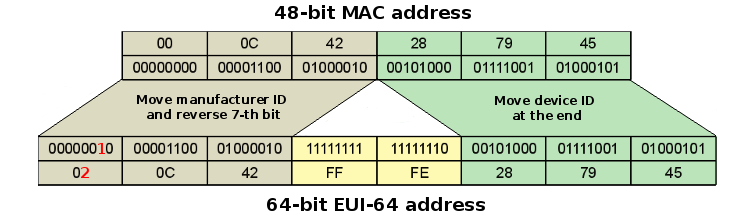
The image above illustrates the conversion process. When the result is converted to colon-hexadecimal notation, we get the interface identifier 20C:42FF:FE28:7945. As a result, the corresponding link-local address is
FE80::20C:42FF:FE28:7945/64
In RouterOS, if the EUI-64 parameter of an address is configured, the last 64 bits of that address will be automatically generated and updated using interface identifier. The last bits must be configured to be zero for this case. Example:
[admin@MikroTik] > add address=fc00:3::/64 interface=ether3 eui-64=yes
[admin@MikroTik] > print
Flags: X - disabled, I - invalid, D - dynamic, G - global, L - link-local
# ADDRESS INTERFACE ADVERTISE
...
5 G fc00:3::20c:42ff:fe1d:3d4/64 ether3 yes
[admin@MikroTik] > set ether3 mac-address=10:00:00:00:00:01
[admin@MikroTik] > print
Flags: X - disabled, I - invalid, D - dynamic, G - global, L - link-local
# ADDRESS INTERFACE ADVERTISE
...
5 G fc00:3::1200:ff:fe00:1/64 ether3 yes
Configuring IPv6 Address
This example shows how to set up simple addressing with global IPv6 addresses between two routers.
R1 configuration:
/ipv6
add address=2001:DB8::1/64 interface=ether1 advertise=no
R2 configuration:
/ipv6
add address=2001:DB8::2/64 interface=ether1 advertise=no
Check the address list:
[admin@R1] /ipv6 address> print
Flags: X - disabled, I - invalid, D - dynamic, G - global, L - link-local
#    ADDRESS                                     FROM-POOL INTERFACE     ADVERTISE
0  G 2001:db8::1/64                                        ether1        no
3 DL fe80::219:d1ff:fe39:3535/64                           ether1        no
Notice that our added address has a G flag indicating that this address can be globally routed. We also have a link-local address on the interface which is created automatically for every IPv6-capable interface.
Test connectivity:
[admin@R1] /ipv6 address> /ping 2001:DB8::2
HOST                                     SIZE TTL TIME  STATUS
2001:db8::2                 56  64 12ms  echo reply
2001:db8::2                 56  64 0ms   echo reply
    sent=2 received=2 packet-loss=0% min-rtt=0ms avg-rtt=6ms max-rtt=12ms
SLAAC IPv6 Address
If under IPv6/Settings menu "accept-router-advertisements" option is enabled and the router receives a Router Advertisement packet, then the SLAAC IPv6 address will be automatically assigned to the interface on which the advertisements were received. This address will have DG flags meaning that the address is dynamic and global. Such addresses will show valid and lifetime parameters.
[admin@R1] /ipv6/address/print detail where dynamic && global
Flags: X - disabled, I - invalid, D - dynamic; G - global, L - link-local
 0 DG address=2001:db8::::ba69:f4ff:fe84:545/64 from-pool="" interface=ether1
      actual-interface=test_fp eui-64=no advertise=no no-dad=no valid=4w2d
      preferred=1w
If SLAAC addresses are accepted, then also dynamic route toward the Internet will be generated. It will also contain a few limitations if specified on the advertisement packet. For example, hop-limit and MTU. If multiple addresses are received on the same interface, then the lowest of the MTU values per interface will be used.
[admin@R1] /routing/route/print detail where slaac
Flags: X - disabled, F - filtered, U - unreachable, A - active;
c - connect, s - static, r - rip, b - bgp, o - ospf, d - dhcp, v - vpn, m - modem, a - ldp-address, l - ldp-mapping, g - slaac, y - bgp-mpls-vpn;
H - hw-offloaded; + - ecmp, B - blackhole
 Ag + afi=ip6 contribution=active dst-address=::/0 routing-table=main
       pref-src="" gateway=fe80::ba69:f4ff:fe84:7b2%ether1
       immediate-gw=fe80::ba69:f4ff:fe84:7b2%ether1 distance=1 scope=30
       target-scope=10 belongs-to="slaac" mtu=1400 hoplimit=10
       debug.fwp-ptr=0x201C2C00